

Beyond Intelligence: Where Knowledge Becomes Meaning
Atefeh Abdolmanafi, PhD
Artificial intelligence (AI) is transforming radiology. As an academic, I find the excitement justified. AI can detect patterns beyond human perception, analyze massive datasets, and uncover relationships hidden within complex medical images.
But I have often found myself uncomfortable with a common question:
“Will AI replace radiologists?”
For years, I could not explain why this question felt incomplete to me. Then, one year ago, I encountered radiology from a very different perspective, one that changed my understanding of the fundamental role of AI. I realized that the deeper question is not whether machines can become more capable, but whether capability and judgment are the same thing. Answering that question requires looking beyond technology into anthropology, philosophy, and the nature of human expertise itself.
The Space Between Evidence and Action
After receiving a cancer diagnosis, I instinctively tried to approach the reports, pathology findings, and imaging assessments exactly as I would approach a scientific paper. As a researcher, I have been trained to make sense of complex problems by turning to evidence, studying the details, and trusting that a deeper understanding of the data will bring greater clarity. So, I read the medical evidence and examined the report terminology, hoping it would lead to a sense of certainty. Finding none, I assumed that what I needed was more information, perhaps the kind of information an AI model could discover from some nuance in the data.
However, the lack of information was not the problem. The abnormality had already been detected, the pathology had already been reported, and all the data were available. What remained uncertain was what the data meant and what should happen next. How confident should my doctor and I have been in the imaging findings? Did the imaging and pathology tell a consistent story? Was additional imaging necessary? Did the risk of missing disease outweigh the risk of overtreatment?
In speaking with my radiologist, I was seeking a way to make sense of the abnormality that had already been detected and characterized. The radiologist’s value lay in interpreting what the available evidence meant, how much confidence should be placed in it, what uncertainties remained, and how those uncertainties should influence the next decision.
That experience taught me something I had not fully appreciated as a researcher: the most important question in medicine is often not, “What is likely true?” but rather, “What should be done?”
An AI system can help answer the first question by estimating probabilities, identifying patterns, and quantifying risk. However, it takes a radiologist to answer the second question. Doing so requires judgment, responsibility, and accountability. This distinction is particularly important in radiology because radiologists operate at the intersection of evidence and action. They do more than detecting abnormalities. They assume responsibility for interpreting uncertainty, communicating significance, and guiding decisions that carry real consequences for patients.
Wisdom Beyond Prediction
The distinction between data collection and judgment is not a new concern. More than two thousand years ago, long before the first radiologists, let alone the first AI models, Aristotle distinguished between techne and phronesis in Nicomachean Ethics. Techne refers to technical capability—the ability to calculate, classify, predict, and execute. Phronesis refers to practical wisdom—the ability to make sound judgements under conditions of uncertainty. AI is rapidly becoming extraordinary at techne. It can identify patterns, estimate probabilities, quantify risk, and generate recommendations. But AI cannot achieve phronesis.
As long as human patients need care, there must be human radiologists. The anthropologist Clifford Geertz argued in The Interpretation of Cultures that humans are “animals suspended in webs of significance” that they themselves have spun. We do not simply collect information; we create meaning from it. A lesion is not only a collection of pixels. For a patient, it may represent fear, uncertainty, hope, survival, or a life-altering decision. For a clinician, it may shape a course of action. For a scientist, it may become a question to investigate. The image remains the same, but its meaning changes with the human context in which it is interpreted. Understanding emerges not from the image alone, but from the radiologist interpreting that image within a broader human context.
The Human Art of Making Tools
Anthropologists have long argued that humans are distinguished not by strength or speed, but by their ability to create tools (e.g., Gesture and Speech by Leroi-Gourhan). The history of civilization includes many examples of tools that have extended human capabilities. Just as the telescope extended vision, the microscope extended observation, and the computer extended computation, AI extends our capacity for pattern recognition. Viewed through this lens, AI is the latest expression of a deeply human tendency: building tools that amplify our capabilities.
I believe AI will become indispensable to radiology, not because it is a radiologist, but because it is a tool. AI will improve detection, efficiency, and scientific discovery. The radiologist of the future may spend less time searching for findings and more time exercising their judgement, communicating meaning, and helping patients navigate uncertainty.
The next time someone asks, “Will AI replace radiologists?”, I hope you will reassure them that this is not the core question. Not because AI is incapable of extraordinary things, but because the question misunderstands both AI and radiology and underestimates their power together. The future of radiology will be a partnership between knowledge and wisdom. And that partnership may ultimately be more powerful than either alone.
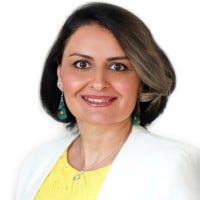
Atefeh Abdolmanafi is a researcher with a master’s degree in physics and a Ph.D. in computer science, specializing in medical image analysis, which she obtained from Université du Québec, Montreal, QC, Canada, in 2018. She has made advancements in cardiovascular imaging, with a focus on Intravascular Optical Coherence Tomography. Currently based at the University of Michigan’s Department of Radiology in Ann Arbor, MI, USA, Dr. Abdolmanafi specializes in color flow ultrasound technologies, driving innovation in medical imaging. Committed to interdisciplinary excellence, she blends art and science to inspire creativity and enhance healthcare solutions.