

Measuring the Journal’s Impact
by Charles E. Kahn, Jr, MD, MS, Editor, Radiology: Artificial Intelligence
About 15 years ago, when I chaired the Publications Committee for the American Roentgen Ray Society, I would tell the AJR’s editors not to obsess about the journal’s Impact Factor. Don’t worry about it, I said. There are so many other ways to measure a journal’s influence.
Of course, now that I’m a journal editor, what I do obsess about, at least a little? You guessed it.
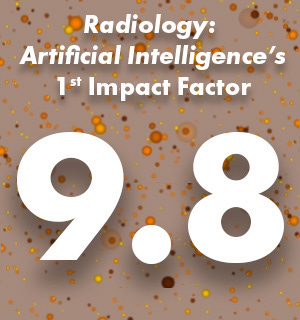
This past month, after 4½ years of publication, Radiology: Artificial Intelligence received its first official “Journal Impact Factor” score. I’m very proud to announce our debut Impact Factor score of 9.8. Our Journal Citation Index has placed Radiology: Artificial Intelligence in the top quartile of journals— in both the “Radiology, Nuclear Medicine, and Medical Imaging” and “Computer Science, Artificial Intelligence” categories.
So, what is a journal’s Impact Factor? It’s the number of citations in one year per citable article published in the two preceding years. Thus, our 2022 Impact Factor reflects citations of papers published in 2020 and 2021.
Of course, Impact Factor was never intended to be used to judge the “quality” of a journal. In fact, it was meant to provide information about the relative amount of scholarly work across disciplines. That said, though, it’s a widely followed index. Many authors, particularly in Europe and Asia, select a journal for their work in part based on its Impact Factor. Without one, we were at a bit of a handicap. Now that we have one, we hope it will encourage authors to send us their best work for consideration.
The journal’s success to date is a testament to the efforts of a large number of people. Our reviewers and Editorial Board members have generously shared their knowledge and expertise to provide thoughtful and constructive feedback to authors. RSNA’s Board of Directors has provided support, and the talented and hardworking RSNA Publications Department staff have guided the journal’s operations.
Our Deputy Editors deserve particular credit: they have defined the scientific quality of the work we publish. In addition to their individual strengths, our Deputy Editors bring diverse expertise: in clinical radiology, computer science, machine learning, biomedical informatics, engineering, mathematics, biostatistics, and even genetics.
Our extraordinary Deputy Editors are:
Mariam Aboian, MD, PhD
William Hsu, PhD
Jayashree Kalpathy-Cramer, PhD
Despina Kontos, PhD
Ronnie Sebro, MD, PhD
I remain deeply grateful to this core editorial team, and to all of the authors, reviewers, Editorial Board members, publications staff, and readers who have supported this endeavor.
Our overarching goal is to assure that Radiology: Artificial Intelligence is a site for the highest quality of scientific work. We hope that prospective authors will share that vision.
Again, this Editor extends his heartfelt thanks to all who have helped support the journal’s successes to date.

Charles E. Kahn, Jr, MD, MS is professor and vice chair of radiology at the University of Pennsylvania, and editor of Radiology: Artificial Intelligence.
Follow him on Twitter: @cekahn, @Radiology_AI