

The Cloud Has Never Been Weightless: The Shadow Infrastructure of Agentic AI
Jawed Nawabi, MD, MHBA, MSc
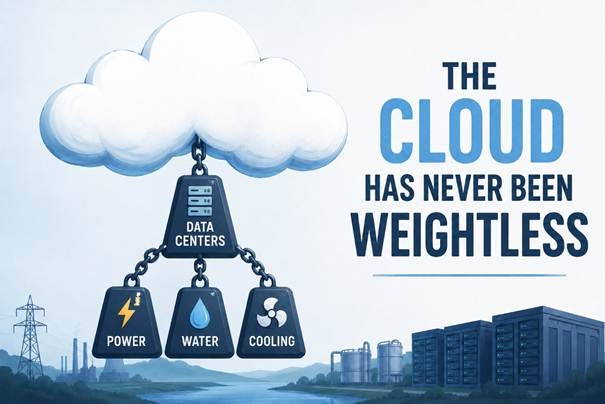
The word “cloud” carries a sense of weightlessness. It suggests something diffuse, floating, and almost immaterial, a place where computation happens without occupying real space. The language of AI often reinforces this abstraction. We speak of models, parameters, prompts, and cloud-based systems, letting the physical substrate remain largely out of view.
But, the cloud has never been weightless. And it is not small, either.
From Episodic AI to Persistent Agents
The next phase of AI will not be limited to passive chatbots or isolated prediction tools, applications with lesser infrastructure demands. The field is moving toward agentic AI.
These agentic systems promise relief from administrative burden and cognitive overload. Yet, they cast a shadow: continuous computation that depends on an AI infrastructural backbone.
That backbone is already visible. In the United States alone estimates suggest there are already more than 4,500 operational data centers, with many more in development. Public maps from DataCenterMap and the Brockovich Data Center Map make this geography visible.
Data Centers Become a National Infrastructure Question
The United States has begun to treat AI infrastructure as a national priority. In January 2025, Executive Order 14141, “Advancing United States Leadership in AI Infrastructure,” addressed federal support for AI infrastructure, including data centers, energy resources, permitting, and reporting requirements. In July 2025, a subsequent executive order, “Accelerating Federal Permitting of Data Center Infrastructure,” emphasized faster permitting, financial support for qualifying data-center projects, and environmental-review streamlining. The policy trajectory is clear: AI data centers have become a bipartisan federal infrastructure issue.
But making data centers a national priority raises the practical question of what actions should be taken to address the issue. A U.S. Department of Energy report estimated that data centers consumed approximately 4.4% of total U.S. electricity in 2023 and could consume 6.7% to 12% by 2028. As new data centers are built, meeting that demand will require the development of a resource-intensive infrastructure to sustain them.
Water use and heat rejection are part of that infrastructure. Data centers must remove heat, and they depend on cooling strategies that typically use large amounts of water resources, a serious concern for the many planned AI data centers that will be located in drought-affected regions in the US. Water access challenges have motivated companies to explore more unusual approaches. Some facilities use evaporative cooling; others use air cooling, liquid cooling, closed-loop systems, or hybrid designs. Microsoft’s Project Natick tested whether data centers could be deployed underwater near coastal populations, where cooling might be more efficient and latency lower. The idea has continued elsewhere. In 2026, an offshore wind-powered underwater data center off Shanghai’s Lingang Special Area was reported to have entered operation, using seawater for cooling and electricity from offshore wind.
Big Tech Is Buying the Energy Stack
Large technology companies appear to understand that the next bottleneck for AI may not only be chips or models, but also the infrastructure required to sustain it. Amazon and Meta have both entered long-term agreements with energy suppliers, including nuclear-power arrangements, to support the anticipated growth of AI and cloud computing. These examples show that leading AI companies are no longer simply buying electricity. They are not only securing firm power, but also shaping the energy infrastructure needed to run AI systems at scale.
Why Medicine Should Care
Healthcare already depends on invisible infrastructure, and radiology is one of the clearest examples. PACS downtime, cloud archive interruptions, and network failures reveal how much imaging care is mediated by systems that radiologists do not control and often cannot see. Agentic AI could deepen this dependency by embedding persistent computational agents into reporting, protocoling, worklist prioritization, imaging follow-up, and care coordination.
Healthcare therefore needs AI infrastructure literacy, and radiology could help lead it. Health systems should ask where AI systems run, what infrastructure they depend on, and what happens when that infrastructure fails. Knowing these things allows radiology departments to build contingencies, preserve meaningful backup workflows, and understand the infrastructure on which imaging care increasingly depends.
The cloud has never been weightless. To reap the benefits of AI, radiology must also bear the weight of the cloud in megawatts, cooling water, land, transmission lines, backup generators, nuclear power contracts, and, increasingly, steel modules placed beneath the sea.

Dr. Jawed Nawabi is a neuroradiology specialist and assistant professor at Charité – Universitätsmedizin Berlin, where he serves as campus lead for one of Charité’s three major clinical campuses. At Charité, he heads the Neuroradiology AI Imaging Lab as well as the institute’s digital transformation division, where he oversees the implementation and governance of AI systems in clinical practice. His research focuses on the development, evaluation, and clinical integration of large language models and deep learning–based imaging models in radiology. He holds a Master’s degree in AI in Healthcare and is an alumnus of the Digital Health Clinician Scientist Program. In his current work, he leads projects on digital twins for neuro-oncological tumor boards, exploring how AI-driven models can support multidisciplinary clinical decision-making. He is a current member of the Trainee Editorial Board for Radiology: Artificial Intelligence.
Enjoyed this perspective? Check out Dr. Nawabi’s previous post:
Supply Chain Constraints: The Hidden Dependencies Behind Radiology AI

Artificial intelligence in radiology is often described as if it were detached from the material world, as if it merely constitutes software that can be trained, updated, and deployed wherever enough data exists. In this view, AI scales easily, improves continuously, and spreads with little friction. This description is appealing in its simplicity, but …